The Tsinghua-INSEAD Dual Degree EMBA (TIEMBA) program hosted a session of its "Future Tech·Future Mind" masterclass series on May 14, 2026. The latest session focused on multipolarity and the future of international cooperation in an age of geopolitical recession, providing a platform for alumni and others interested in global governance to discuss trends in global development.
Vuk Jeremić, who has long been dedicated to observing and studying the evolution of the global landscape, was the guest speaker. He is president of the Center for International Relations and Sustainable Development, co-founder of the Global Preventive Diplomacy Initiative, former minister of foreign affairs of Serbia, president of the 67th Session of the United Nations General Assembly, professor of practice at the Sciences Po Paris School of International Affairs and visiting professor of practice at Tsinghua University.
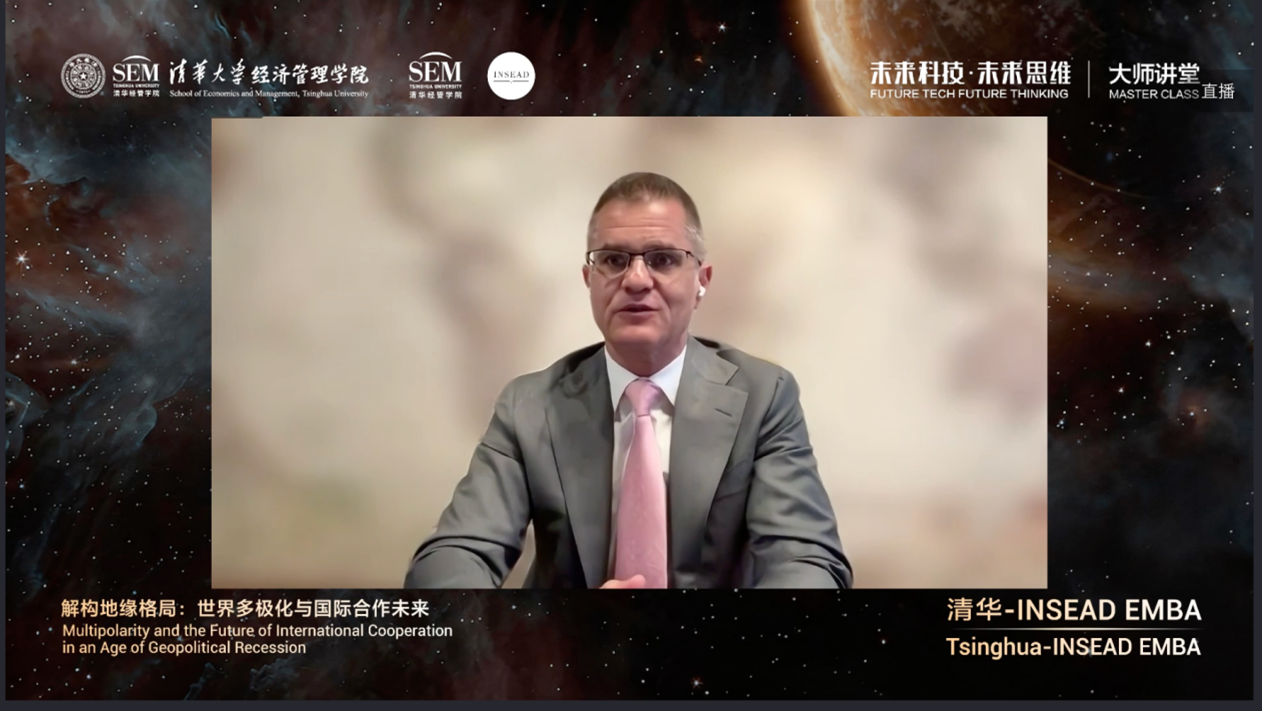
Vuk Jeremić delivers a lecture in a session of TIEMBA's "Future Tech · Future Mind" masterclass series, May 14, 2026.
From international relations to industrial layout, from AI governance to global cooperation, Professor Jeremić drew on his decades of experience in international diplomacy and governance to unpack the underlying logic of profound global transitions, offering highly practical references for decision-making.
Jeremić delivered his presentation in five dimensions: the concept, causes and key parameters of geopolitical recession; multipolarity and its implications; the future of international cooperation; Europe at a crossroads; and the special position of Serbia and the Western Balkans.
Jeremić said he believes that geopolitics, like the economy, follows distinct cycles of prosperity and decline. He noted that since World War II, the world has gone through three phases: Cold War confrontation, unipolar dominance and the rise of multipolarity. After the Cold War, the United States entered a "unipolar moment" with overwhelming advantages in military, economic, cultural and technological fields. Later, amid turbulence in Europe, China’s emergence as a global economic and technological power, and the rapid advancement of borderless globalization, the world has gradually shifted from unipolarity to multipolarity. He stressed that cooperative multipolarity is the choice for stability and prosperity that serves the interests of all humanity, and that China is becoming a key force in advancing the building of a cooperative multipolar world.
Addressing audience questions on China's manufacturing global layout, China-EU industrial cooperation, and opportunities and risks in the European market, Jeremić shared his insights from a first-hand European perspective. He stated that Europe currently faces three strategic dilemmas. First, the ongoing tensions between Russia and Ukraine has led to volatile security conditions and enormous economic pressure. Second, its relations with the US have weakened, the transatlantic alliance is no longer solid, and Europe has been forced to compromise and accommodate. Third, its relations with China have become strained, with barriers erected in trade, investment, new energy, automobiles and other sectors, which runs counter to economic rationality. In conclusion, he called for the urgent establishment of global AI governance rules, to be jointly advanced by major powers including China, the US and Europe, so as to prevent technology abuse, unintended risks and bloc confrontation.
Source: EMBA Programs
Editor: Ren Zhongxi

 Latest News