The 13th Mostly Operations Management (Mostly OM) workshop was held at Tsinghua University School of Economics and Management (Tsinghua SEM) from May 29 to 30, 2026.
The Mostly OM workshop is a premier international academic platform in operations management, established by Tsinghua SEM. This year's event, co-sponsored by Tsinghua SEM and Tsinghua University's Research Center for Contemporary Management, brought together nearly 200 faculty members and students from over 60 universities worldwide.
The workshop was co-chaired by Chen Jian, director of the Research Center for Contemporary Management at Tsinghua University and Tsinghua University's Distinguished Professor of Arts, Humanities and Social Sciences, David Yao, the Piyasombatkul family professor at Columbia University, and Dai Jiangang, the Leon C. Welch professor at Cornell University and the honorary dean of the School of Data Science at the Chinese University of Hong Kong, Shenzhen.
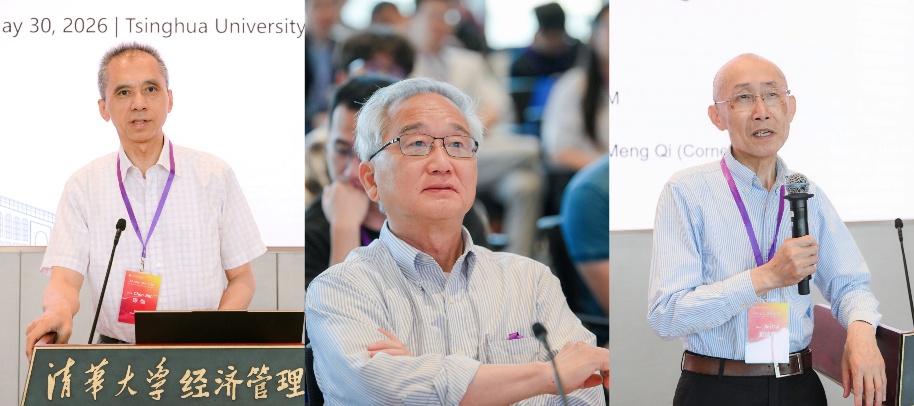
Co-chairs of the 13th Mostly OM workshop (left to right: Chen Jian, David Yew, Dai Jiangang).
The 13th Mostly OM workshop focused on the empowerment and challenges that large language models (LLMs) and agents bring to operations management research, and featured plenary presentations from 11 internationally renowned scholars. Participants included senior professors in the field of operations management, such as Guillermo Gallego, dean of the School of Data Science at the Chinese University of Hong Kong, Shenzhen, Chen Li from Cornell University, and Ge Dongdong from Shanghai Jiao Tong University. The workshop also featured a number of highly active young and mid-career scholars, including Hu Xing from the University of Hong Kong, Lu Haihao from the Massachusetts Institute of Technology, Qin Hanzhang from the National University of Singapore, Tang Wenpin from Columbia University, Sophie Yu from the Wharton School, Zhang Xiaowei from the Hong Kong University of Science and Technology, and Zhou Yuan from Tsinghua University.
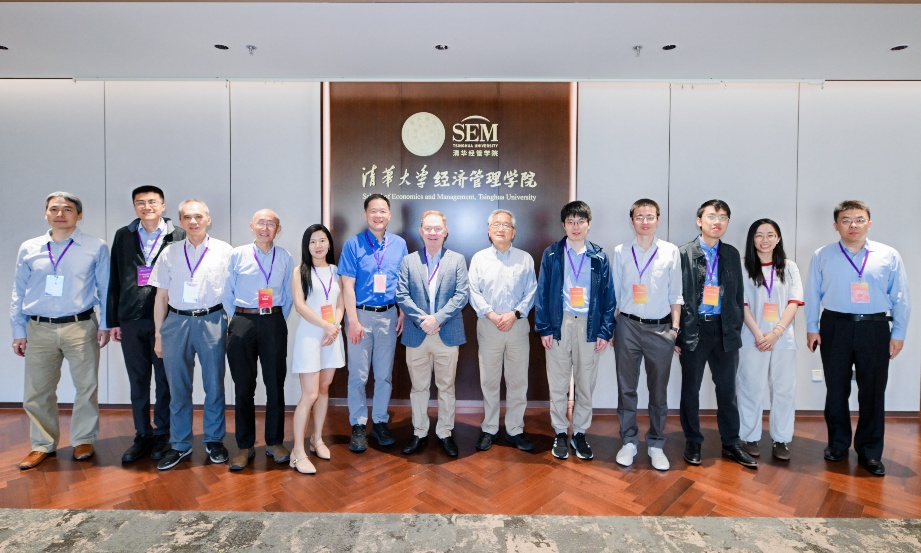
Guests pose for a group photo.
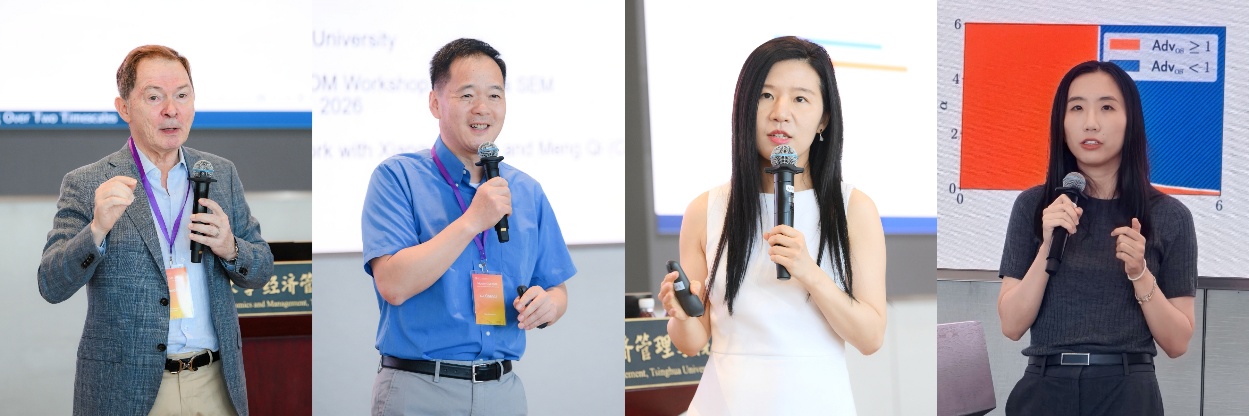
Guillermo Gallego, Chen Li, Hu Xing and Sophie Yu (left to right) deliver their reports.
Revenue management and market mechanism design are classic areas of operations management research. Guillermo Gallego introduced opposing martingale behavior on different observation clocks. Li Chen presented a data-driven revenue-maximizing contextual pricing problem with a semi-parametric model of customer valuation. Hu Xing discussed the design and management of token-based favor-trading platforms. Sophie Yu explained how a fixed flexibility budget should be allocated across the two sides of a balanced bipartite matching market.
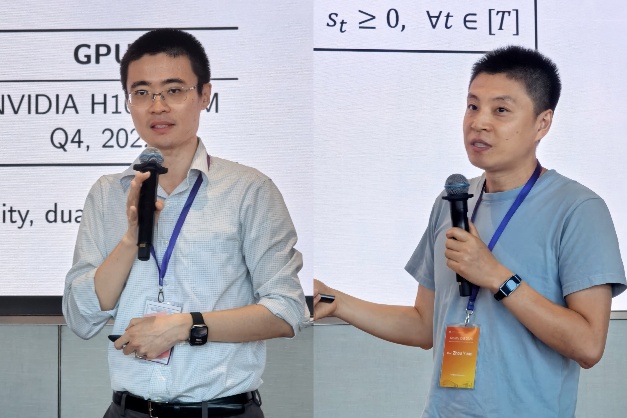
Lu Haihao (left) and Zhou Yuan deliver their reports.
Optimization methods constitute fundamental tools in operations management research and have consistently been a central theme of the workshop series. Lu Haihao spoke about GPU-accelerated linear programming, while Zhou Yuan outlined online linear programming in inventory management systems.
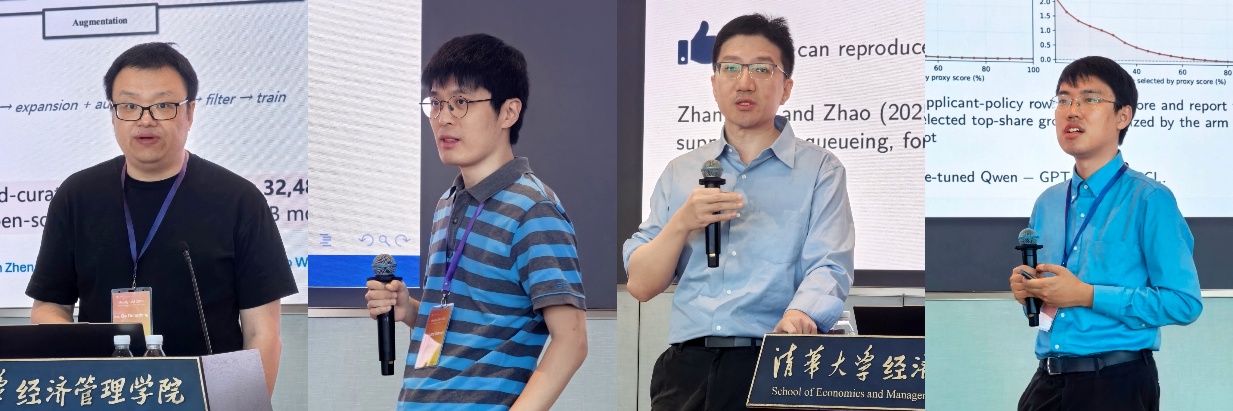
Ge Dongdong, Tang Wenpin, Zhang Xiaowei and Qin Hanzhang (left to right) deliver their reports.
LLMs and generative artificial intelligence are current research hotspots in the field of operations management. Ge Dongdong presented a unified framework for self-evolving LLM-based decision systems. Tang Wenpin focused on a novel two-stage procedure that leverages LLMs to automate the design of tailored simulation optimization algorithms. Zhang Xiaowei introduced an LLM‑powered multi‑agent simulation framework for optimizing service operations. Qin Hanzhang focused on how to efficiently explore decision spaces shaped by generative models, and how to safely incorporate learned signals into decision-making.
The workshop included a dedicated panel discussion on the integrated application of LLMs, agents and operations management. Chaired by David Yao, the session brought together four scholars – Ge Dongdong, Lu Haihao, Tang Wenpin and Zhang Xiaowei – who shared their insights on frontier AI technologies. Participants engaged in deep and rigorous discussions on both the practical applications of AI in operations management and the future directions of disciplinary research and education.
The workshop provided a high-quality platform for academic exchange and collaboration in China's operations management field, injecting new momentum into disciplinary development and talent cultivation. During the two-day event, participants not only learned about cutting-edge academic advances in operations management, but also engaged in direct, in-depth scholarly exchanges with world-leading researchers.
Since its inaugural session in 2010, the Mostly OM workshop has earned broad recognition from scholars in China and internationally. It has evolved into a vital platform facilitating collaboration between Chinese operations management researchers and globally preeminent scholars. To date, the event has attracted over 4,000 participants from around the globe, with its academic influence and reputation growing steadily each year.
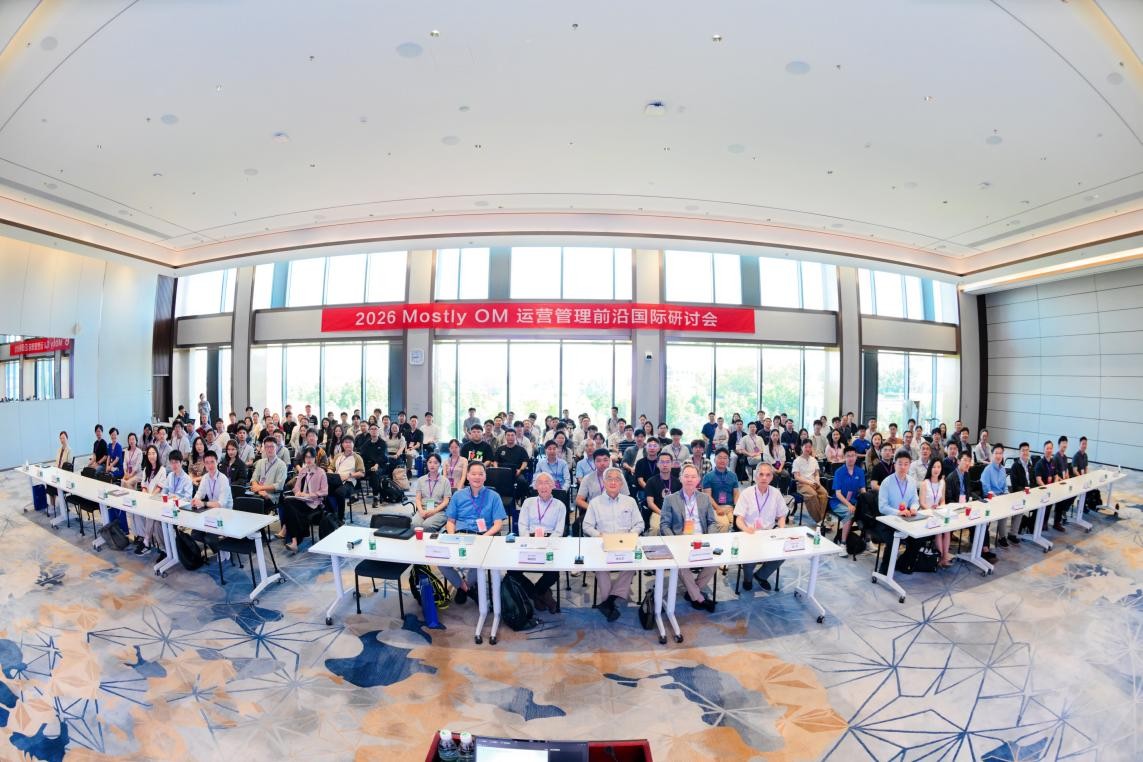
Participants in the Mostly OM 2026 workshop
Source: Research Center for Contemporary Management, Tsinghua University
Editor: Ren Zhongxi

 Latest News